Kikka-sai | Events | Miyajima Tourist Association









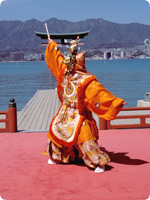
Bugaku (court dance and music) introduced into Miyajima from Kyoto by Kiyomori Taira is accompanied by gagaku. Around 20 pieces including "Ryo-oh", "Nasori" "Manzairaku" and "Engiraku" are still handed down to Itsukushima Shrine from the latter period in the twelfth century.
Bugaku is originally from India, Vietnam, China and the Korean Peninsura, but it does not exist any place other than Japan today.
Even it does not remain in India, China, and the Korean Peninsura now. It is conserved in the Imperial Household Agency, Shitenno-ji Temple in Osaka, Itsukushima Shrine in Miyajima and other several places in Japan.
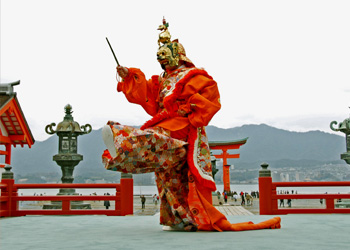
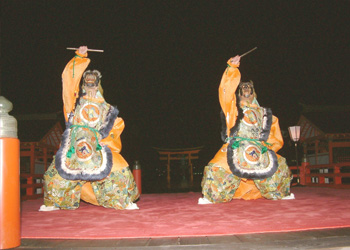
| Toka-sai (Peach Blossom Ceremony) |
Date | From about 17:00 on April 15 |
|---|---|---|
| Program | Enbu, Manzairaku, Engiraku, Tourika, Ikkyoku, Soriko, Sanju Kitoku, Ryo-oh, Nasori, Chohgeishi | |
| Kikka-sai (Chrysanthemum Ceremony) |
Date | From about 17:00 October 15 |
| Program | Enbu, Manzairaku, Engiraku, Gaden, Ikkyoku, Soriko, Sanju, Kitoku, Ryo-oh, Nasori, Chohgeishi |
Other performances of court dance and music
| Name | Date | Program |
|---|---|---|
| Saitan(new year's day) | 5:00 a.m., January 1, after the ceremony |
Enbu |
| Futsuka-sai | 9:00 a.m., January 2 after the ceremony |
Manzairaku, Engiraku |
| Genshi-sai | 9:00 a.m., January 3 after the ceremony |
Taiheiraku, Komaboko, Kotokuraku, Ryo-oh, Nasori, Chohgeishi |
| Chikyu-sai | 5:30 a.m., January 5 after the ceremony |
Enbu, Kanshu, Ringa, Batou, Genjohraku, Chohgeishi |
| Tencho-sai | 10:00 a.m., February 23 after the ceremony |
Enbu, Manzairaku, , Engiraku, Ryo-oh, Nasori, Chohgeishi |
| Praying Ceremony of Emperess Suiko | 9:00 a.m., May 18 after the ceremony |
Enbu, Manzairaku, Engiraku, Ryo-oh, Nasori, Chohgeishi |
| Ichidate-sai | 9:00 a.m., June 5 in old calendar after the ceremony |
Enbu, Manzairaku, Engiraku, Ryo-oh, Nasori, Chohgeishi |
| Sannoh Shrine ceremony | 10:00 a.m., October 23, iduring the ceremony |
nonconstant |